





Good to know
Short answers to common questions about tyres. General information; if in doubt, ask at the workshop.
What does the tyre size (e.g. 205/65 R15) mean?
The size 205/65R15 on a tyre means its width, height and diameter. In practice this means the tyre is 205 mm wide, the height from the rim to the edge of the tyre is 65% of the tyre's width (133 mm in this case) and the tyre diameter is 15 inches.
Load index
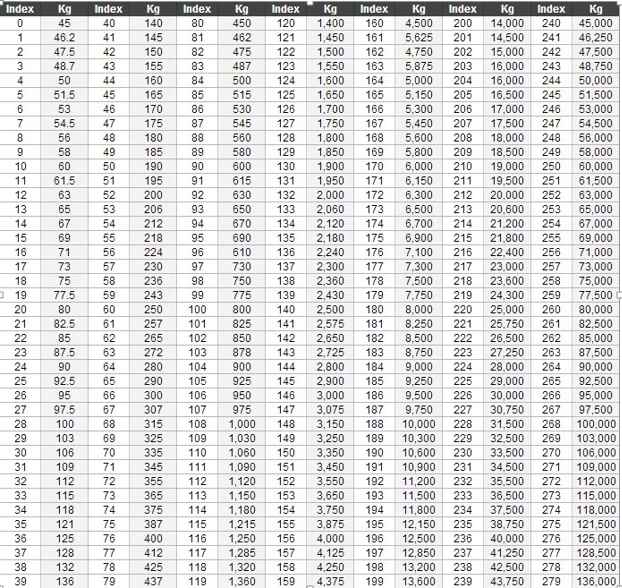
The load index is a number on the sidewall of the tyre. It shows the greatest load the tyre can carry. In the table below you can look up the load index to find the maximum load in kilograms the tyre can carry. The load capacity must be at least half of the load the axle carries.
Speed index
The speed index is a letter on the sidewall of your tyre that shows the maximum speed the tyre can be driven at.
The speed ratings are: J (100 km/h), K (110 km/h), L (120 km/h), M (130 km/h), N (140 km/h), P (150 km/h), Q (160 km/h), R (170 km/h), S (180 km/h), T (190 km/h), U (200 km/h), H (210 km/h), V (240 km/h), W (270 km/h), Y (300 km/h).
You must never fit a tyre with a lower speed index than the one fitted as original equipment on your car. You can, however, fit a tyre with a higher index.
The law prohibits fitting a tyre whose speed index is lower than the one fitted by the manufacturer as original equipment. The same applies to the load index.
Winter tyres whose speed index is one letter lower than that of the summer tyres may be fitted. For example, if your vehicle uses summer tyres with index V, winter tyres with index H may be fitted.
ZR marking
The ZR marking means the tyre can handle speeds above 240 km per hour. The W and Y categories are combined in it. These are high-performance tyres. Sometimes only the letter Z is written on the sidewalls of your tyres.
DOT marking (age of the tyre)
The DOT (Department of Transportation) code on a tyre shows its date of manufacture. It consists of 4 digits that give the week and year the tyre was made.
For example: DOT B94W HWNX 3903. B9: the code of the factory where the tyre was made. 4W: a code specific to the manufacturer of this size. HWNX: an optional code specific to the manufacturer. 3903: the date of manufacture. This tyre was made in week 39 of 2003.
Seasonal tyre change
Fit winter tyres when temperatures settle below about 7 degrees Celsius, summer tyres in spring. Book an appointment online.
By law, vehicles must be equipped with winter equipment between 15 November and 15 March. Winter equipment means either a set of four winter tyres marked M + S with a minimum tread depth of 3 millimetres, or a set of summer tyres with the same minimum tread depth together with snow chains for the driven wheels. 15 March is the day the obligatory use of winter equipment ends and drivers may swap winter tyres for summer ones, although it is sometimes sensible to wait a little longer before changing.